
how to check car spark plugs condition is one of the quickest ways to explain rough idle, weak acceleration, or a sudden drop in fuel economy without throwing parts at the problem.
If your car feels “off,” spark plugs sit near the top of the suspect list because they’re wear items, they live in a harsh environment, and their symptoms overlap with coils, injectors, and vacuum leaks. The good news, you can often learn a lot with a basic inspection and a little pattern recognition.

What trips people up is expecting one “perfect” sign. In real life, plug condition is a mix of color, deposits, gap, and how evenly all cylinders look. This guide shows what to look for, what it usually means, and what to do next without overreacting.
What spark plugs do, and why condition matters
Spark plugs ignite the air-fuel mixture. When they’re healthy, the spark happens consistently, at the right time, under load, in heat, and during cold starts. When they’re worn or fouled, you can get incomplete combustion, misfires, and extra stress on coils and catalytic converters.
According to the U.S. Environmental Protection Agency (EPA), misfires and poor combustion can increase emissions, and unresolved ignition issues can contribute to inspection failures in many states. You don’t need to panic, but you also don’t want to ignore a persistent misfire.
- Performance: hesitation, sluggish throttle response, rough idle
- Efficiency: fuel economy often drops gradually, so it’s easy to miss
- Reliability: hard starts, especially in cold weather
- Protection: repeated misfires can overheat the catalytic converter in some cases
Before you pull plugs: quick symptoms and simple checks
Before you start removing anything, do a few fast checks. They help you avoid blaming plugs when the issue is actually a battery, intake leak, or a failing ignition coil.
Do this first if you can:
- Scan for codes. A P0300 (random misfire) or P0301–P0308 (cylinder-specific) helps you focus.
- Listen at idle. A steady shake or “putt-putt” can point to a misfire, but it’s not plug-exclusive.
- Check maintenance history. If plugs are past their interval, inspection makes sense even without codes.
- Look for obvious oil leaks near plug wells on coil-on-plug engines.

If you have an active flashing check engine light, drive gently and keep trips short until you diagnose it. In many cases, a flashing light indicates an active misfire that can cause damage, and it may be smarter to consult a professional.
Tools and prep to check spark plugs safely
You don’t need a full shop, but you do want the basics so you don’t crack a plug or damage threads.
- Spark plug socket (usually 5/8" or 13/16") with rubber insert or magnet
- Ratchet, short extension, and possibly a wobble extension
- Torque wrench (recommended)
- Feeler gauge or wire gauge for gap
- Compressed air or a can of air to blow debris away from the plug well
- Gloves and a flashlight
Safety and “don’t make it worse” prep: Let the engine cool. Hot aluminum heads and plugs are a bad combination, and you’re more likely to strip threads if you rush. Blow out dirt around the plug before removal so it doesn’t fall into the cylinder.
How to check car spark plugs condition step by step
how to check car spark plugs condition comes down to four things: removal without damage, reading the tip, measuring the gap, and comparing cylinders.
1) Remove and label each plug
Pull one plug at a time and keep it matched to its cylinder. A simple row on a piece of cardboard labeled 1–4 (or 1–6/8) works. Consistency across cylinders is often more important than any one plug looking “a little off.”
2) Inspect the porcelain, shell, and threads
- Cracks in porcelain: can cause spark to leak to ground, replace the plug.
- Oil in the plug well: often points to a valve cover gasket or tube seal leak, not the plug itself.
- Damaged threads: stop and get help if threads look chewed up, thread repair can be delicate.
3) Read the tip: color and deposits
You’re looking at the center electrode, ground strap, and the insulator nose. A normal plug often shows light tan/gray coloring with minimal deposits. That’s the boring outcome, and boring is good.
4) Check the electrode wear and the gap
Measure the gap against the spec for your engine (owner’s manual, service manual, or the under-hood emissions label sometimes lists it). Over time, the gap typically grows as electrodes wear, and that can strain coils.
- Gap too wide: misfire under load, weak acceleration, hard starts
- Gap too tight: can reduce spark kernel, sometimes shows up as roughness or poor combustion
- Rounded electrode edges: common wear sign, usually replace rather than “clean and send it”
5) Compare all plugs as a set
If seven plugs look normal and one looks dramatically different, that’s a clue. It may be a plug issue, but it may also be that cylinder running rich/lean, burning oil, or losing spark from a coil or injector problem.
What spark plug appearance usually means (with a quick table)
Reading plugs is part science, part context. Fuel type, driving pattern, and engine design all influence what you see. Still, these are common patterns that help you decide your next move.
| What you see | What it often points to | What to do next |
|---|---|---|
| Light tan/gray, dry tip | Normal combustion | Re-gap only if plug type allows, otherwise reinstall or replace by interval |
| Dry, sooty black deposits | Rich mixture, lots of idling/short trips, weak spark | Check air filter, scan fuel trims, consider coils, replace plugs if worn |
| Wet with fuel smell | Misfire not igniting that cylinder | Check ignition coil/boot, injector, compression; avoid extended driving |
| Oily, shiny deposits | Oil control issue (rings, valve seals) or oil in plug well | Differentiate tip oil vs. well oil, consider compression/leak-down test |
| White, blistered, eroded tip | Overheating, too lean, wrong heat range, detonation risk | Stop aggressive driving, verify correct plug spec, check cooling and fuel delivery |
| Heavy ash deposits | Additives, oil consumption, sometimes coolant contamination | Replace plugs, investigate underlying cause if it returns quickly |
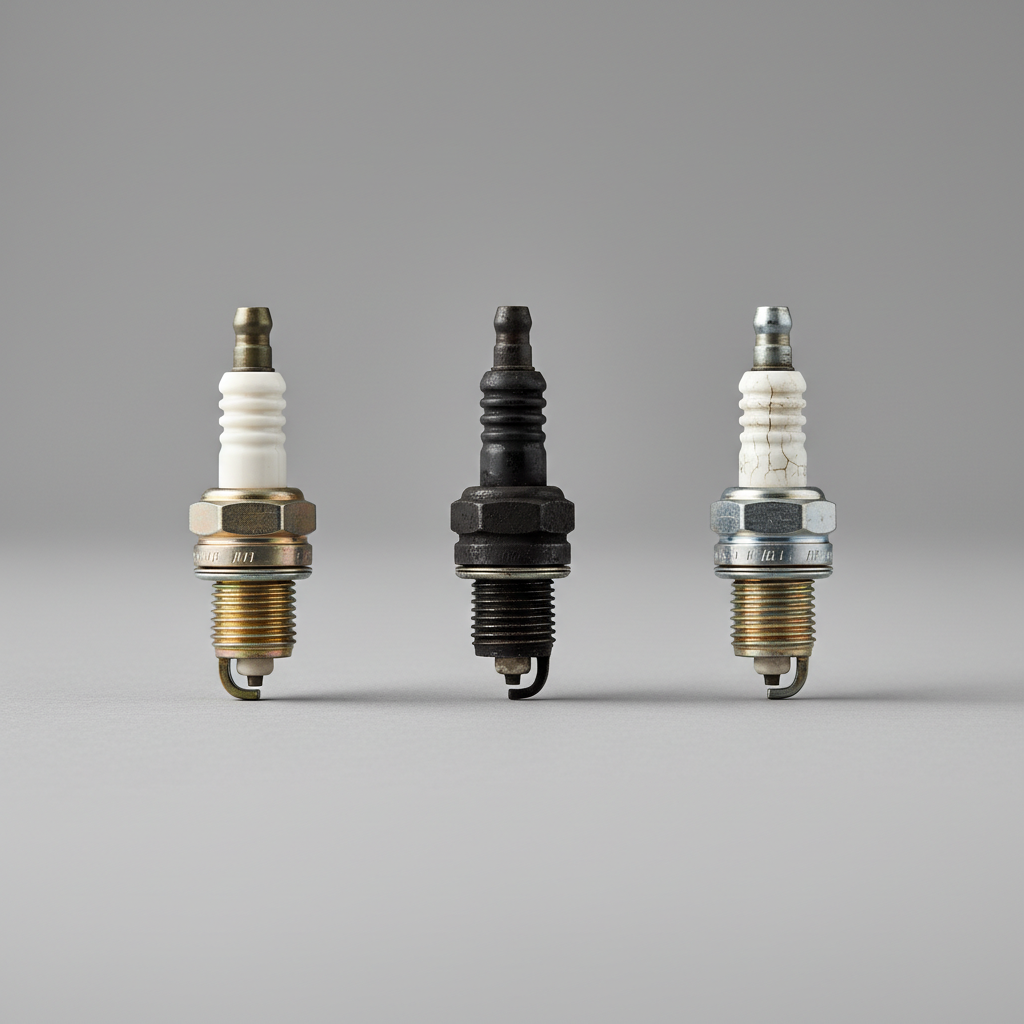
One caution, plug reading gets less “pure” on modern engines because long-life plugs, tight emissions control, and direct injection can change deposit patterns. Use the table as a guide, not a verdict.
Fixes by scenario: what to do after the inspection
This is where people either save money or waste it. If the plugs show normal wear and the gap is out of spec, replacement is usually the cleanest path. If one cylinder looks odd, it’s time to slow down and confirm the cause.
If plugs are simply worn (rounded electrodes, wide gap)
- Replace with the exact type and heat range specified for your engine.
- Use a torque wrench if possible. Over-tightening can damage threads, under-tightening can affect heat transfer.
- If you have iridium/platinum plugs, many manufacturers advise not to re-gap aggressively because tips can be damaged.
If one plug is fuel-fouled (wet) and others are normal
- Swap the ignition coil (or coil pack output) with another cylinder and see if the misfire follows.
- Check the coil boot for carbon tracking, a thin black lightning-like line.
- If the misfire stays on the same cylinder, you may be looking at injector or compression issues.
If plugs show oily deposits
- Confirm whether oil sits in the plug well (often gasket/seal) or on the tip (often combustion-side issue).
- Monitor oil level and consumption trend. Sudden changes deserve attention.
- Consider a professional compression test or leak-down test for clearer answers.
If plugs look overheated (white/blistered)
- Verify plug part number and heat range, wrong plugs can run too hot.
- Check for intake leaks and review scan data if available (fuel trims can hint lean running).
- If you hear pinging/knock, avoid hard acceleration and consult a technician.
Common mistakes that lead to bad diagnoses
- Only checking one plug: you lose the “pattern” across cylinders, which is half the value.
- Cleaning and reinstalling severely worn plugs: it might run better for a minute, then come back.
- Ignoring the coil boot: carbon tracking can mimic plug failure.
- Cross-threading on install: always start plugs by hand, if it doesn’t spin in easily, stop.
- Using anti-seize automatically: some plug manufacturers advise against it because it can alter torque readings; follow the plug maker and vehicle service guidance.
Key takeaways:
- Plug color helps, but gap and wear often tell the real story.
- One weird plug usually means “investigate that cylinder,” not “replace everything.”
- If the check engine light flashes, treat it as time-sensitive.
When it’s time to get professional help
If you’re seeing repeated misfire codes after new plugs, or any sign of overheating, coolant contamination, or damaged threads, a shop visit often saves money. Diagnosis tools like smoke testing for vacuum leaks, injector balance tests, and compression/leak-down testing can narrow the cause quickly.
Also, some engines make plug access tough, and the risk of breaking a plug or damaging threads is real. If you’re unsure, it’s reasonable to ask a professional to handle removal and torque spec installation.
Conclusion: a practical way to keep performance consistent
how to check car spark plugs condition is less about chasing a perfect color chart and more about combining a visual read with gap, wear, and cylinder-to-cylinder comparison. If the plugs are simply worn, replacement usually restores smoothness fast. If one plug looks very different, treat it as a clue and confirm the root cause before buying extra parts.
Action steps that work in most garages: pull and label all plugs, compare them, measure the gap, then decide whether you’re in a straightforward “replace by wear” situation or a “diagnose that cylinder” situation.
FAQ
- How often should I check spark plug condition?
Many drivers check at the service interval or when symptoms show up. Long-life plugs can run tens of thousands of miles, but if you’re troubleshooting a rough idle or misfire, checking sooner makes sense. - Can I check spark plugs without removing them?
Not really. You can scan for misfires and look at live data, but reading deposits, electrode wear, and gap requires removal. - What does a “normal” spark plug look like?
Usually a light tan to gray insulator nose with minimal deposits and no wetness. The exact shade varies by engine and driving style, so consistency across cylinders matters more than chasing a specific color. - Is it okay to clean spark plugs instead of replacing them?
Light cleaning can help for diagnosis, but if electrodes look rounded or the gap is out, replacement tends to be more reliable. With iridium/platinum plugs, aggressive cleaning can damage fine tips. - Do I need to gap new spark plugs?
Many come pre-gapped, but it’s still smart to verify against the spec. Some plug types should not be bent much, so use the right gauge and adjust carefully only if the manufacturer allows. - If only one plug is bad, should I replace all of them?
Often yes if they share the same age and mileage, because the rest are usually close behind. If one plug is abnormal due to a cylinder issue, replacing all plugs is fine, but you still need to address the underlying cause. - Can bad spark plugs damage my engine?
Worn plugs commonly cause drivability issues. A sustained misfire can, in some cases, damage the catalytic converter, so persistent symptoms deserve attention and sometimes professional diagnosis.
If you’re working through misfire codes, debating the right plug type, or you want a faster path than trial-and-error, it can help to bring your plug photos and scan results to a trusted mechanic, you’ll usually get a clearer answer with less parts swapping.